

BUENOS AIRES, Argentina — November 5, 2026. Following world events means moving between publications, languages and time zones. Aplicación Popular brings that flow together in one place: a free news hub that finds stories, translates them into Spanish, prepares summaries and identifies topics, journalists and people mentioned to support reading and research.
Created by artificial intelligence specialist César Casas, the platform combines an automated information pipeline with a software development model built around AI agents. Its approach connects two changes: how software is built and how people access the news.
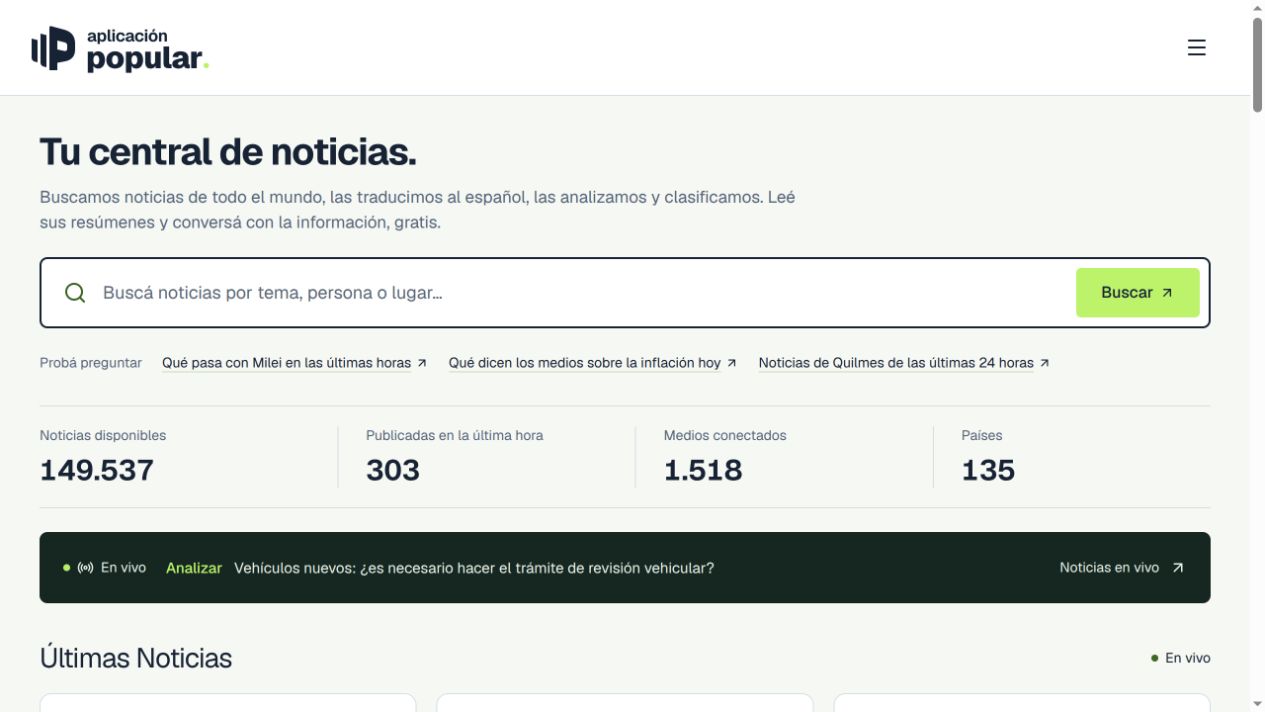
- International reach: when the screenshots for this article were taken, the homepage displayed 1,518 connected media outlets and 135 countries.
- Continuous processing: the institutional overview advertises more than 30,000 news items processed daily. This is a figure reported by the project; dashboard values change with the measurement window.
- Frequent updates: according to the presentation material supplied for this article, the homepage updates every five seconds.
- Access in Spanish: stories from different languages are brought together with summaries, references and tools for deeper research.
From a global stream to usable information
The platform calls its news stream the Firehose. It describes a concrete sequence: download a story from its original publisher, translate it when needed, extract a summary and metadata, and make it available for reading or research.
For journalists, communications teams and analysts, this preparation can reduce the time spent locating scattered publications. Each item retains references to its publisher and source, allowing the summary to serve as a starting point for checking and extending the research.
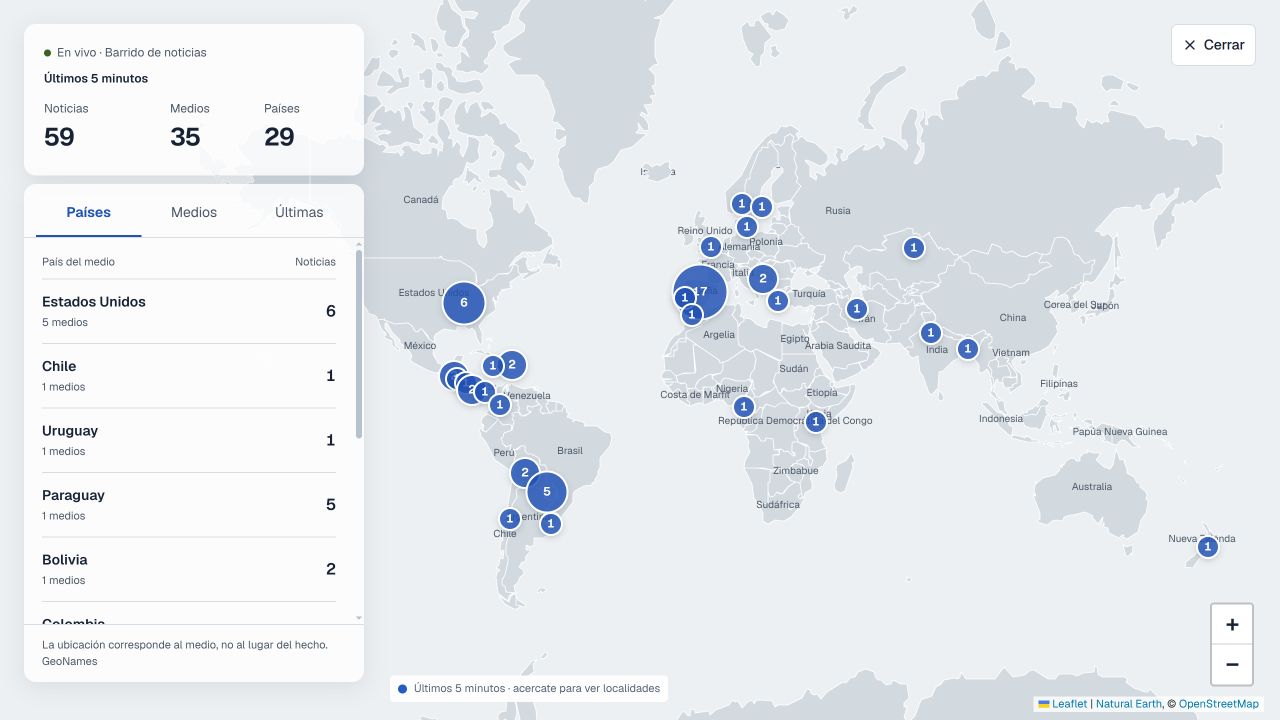
The interactive map lets visitors explore activity by country, outlet and locality. One distinction matters: the location belongs to the media outlet, and is not necessarily where the reported event happened.
Autonomous agents, human decisions
According to the founder's account supplied for this article, Aplicación Popular was developed entirely with AI and is improved through specialized agents working together.
The model includes agents that assess performance and usability, produce reports and propose improvements — including Marcus — alongside a developer agent that writes the code for those changes. César Casas retains oversight and makes strategic decisions when a proposal needs validation or disagreements require resolution.
Autonomy concerns the ongoing execution of technical tasks. Human judgment remains part of the decision process.

Prioritizing coverage and understanding the numbers
The presentation material describes a proprietary scoring algorithm by country and publisher, with a focus on Argentina, Latin America and Spain. It also reports separate processing routes based on length: 96% of texts would contain fewer than 12,000 characters and follow the main flow, while the remaining 4% would be handled by a model for longer articles. These technical figures were supplied for this article.
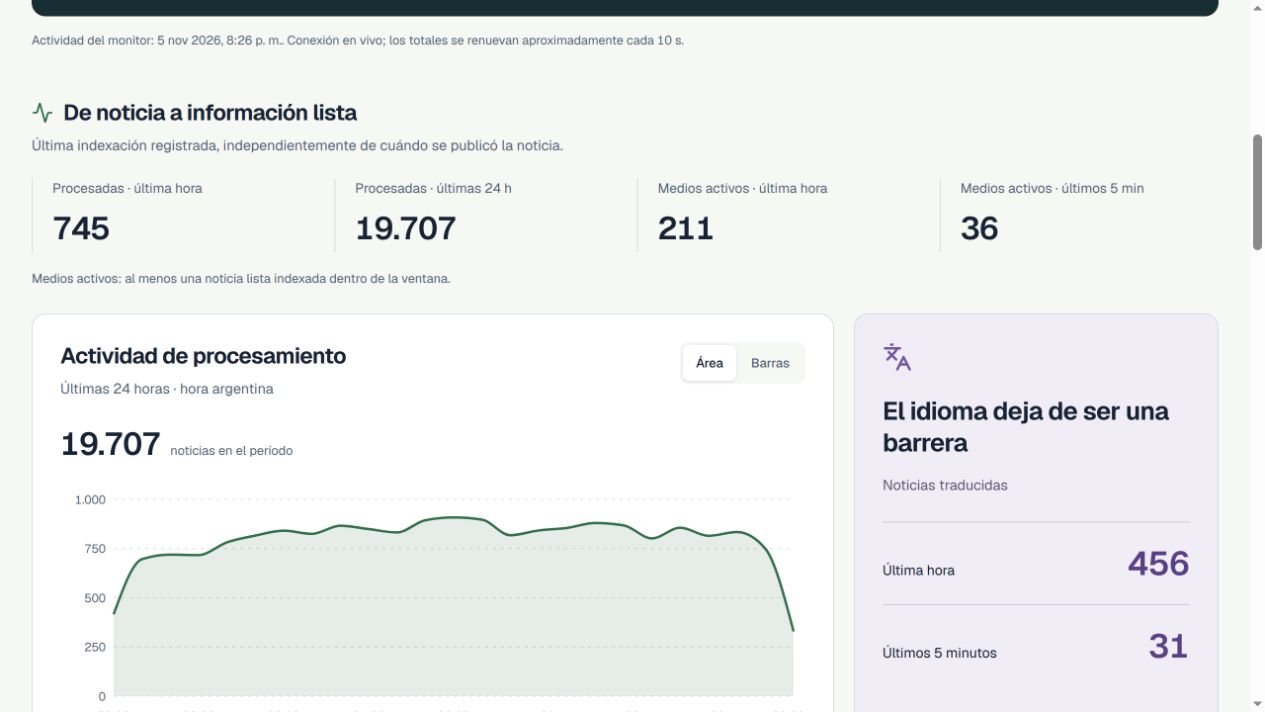
Public statistics offer another view of the operation. In the screenshot taken on November 5, 2026, at approximately 8:26 p.m. Argentina time, the dashboard showed 19,707 news items processed in the previous 24 hours. That section defines the metric by the latest recorded indexing event, regardless of the story's original publication date.
This rolling snapshot documents activity within a specific window. It should not be read as a fixed daily volume or confused with the historical total, pending items or stories dated within the previous 24 hours. The statistics dashboard provides current values.
Helios: research with references
Beyond reading summaries, the platform presents Helios, an agent for querying news, comparing coverage and preparing reports with sources, charts, diagrams and PDF downloads. The interface states that users must sign in to start a conversation.
The approach grounds responses in retrieved evidence that users can follow and check. Working with sources helps reduce the risk of hallucinations, but does not guarantee error-free results. Reviewing references remains part of responsible research.
Pipelines, or personalized channels, are already included in the current product presentation. Users can describe in natural language which topics to include and which to exclude. The selected stream can feed a portal or a custom integration; using other platforms requires connecting those tools.
An editorial discussion, too
Automation speeds up discovery and analysis while raising questions about oversight, traceability and data security. In the material supplied for this article, Casas describes the challenge as ensuring control of the technology and the security of the data, alongside its growing capabilities.
For strategic communications, the opportunity lies in turning an overwhelming volume of information into an agenda that can be reviewed, compared and placed in context. Sources and editorial judgment continue to give that work its meaning.
Explore the platform: homepage, news map, live statistics, and Firehose, Helios and personalized channels.
Press contact: Natalia Vivas — Strategic Communications & Public Relations. Enquire about this article.
Sources: presentation material supplied for this publication and a direct visit to the public Aplicación Popular website on November 5, 2026. Statements about the agents' internal organization and technical percentages are attributed to that material; screenshots document only the visible interface and figures.